
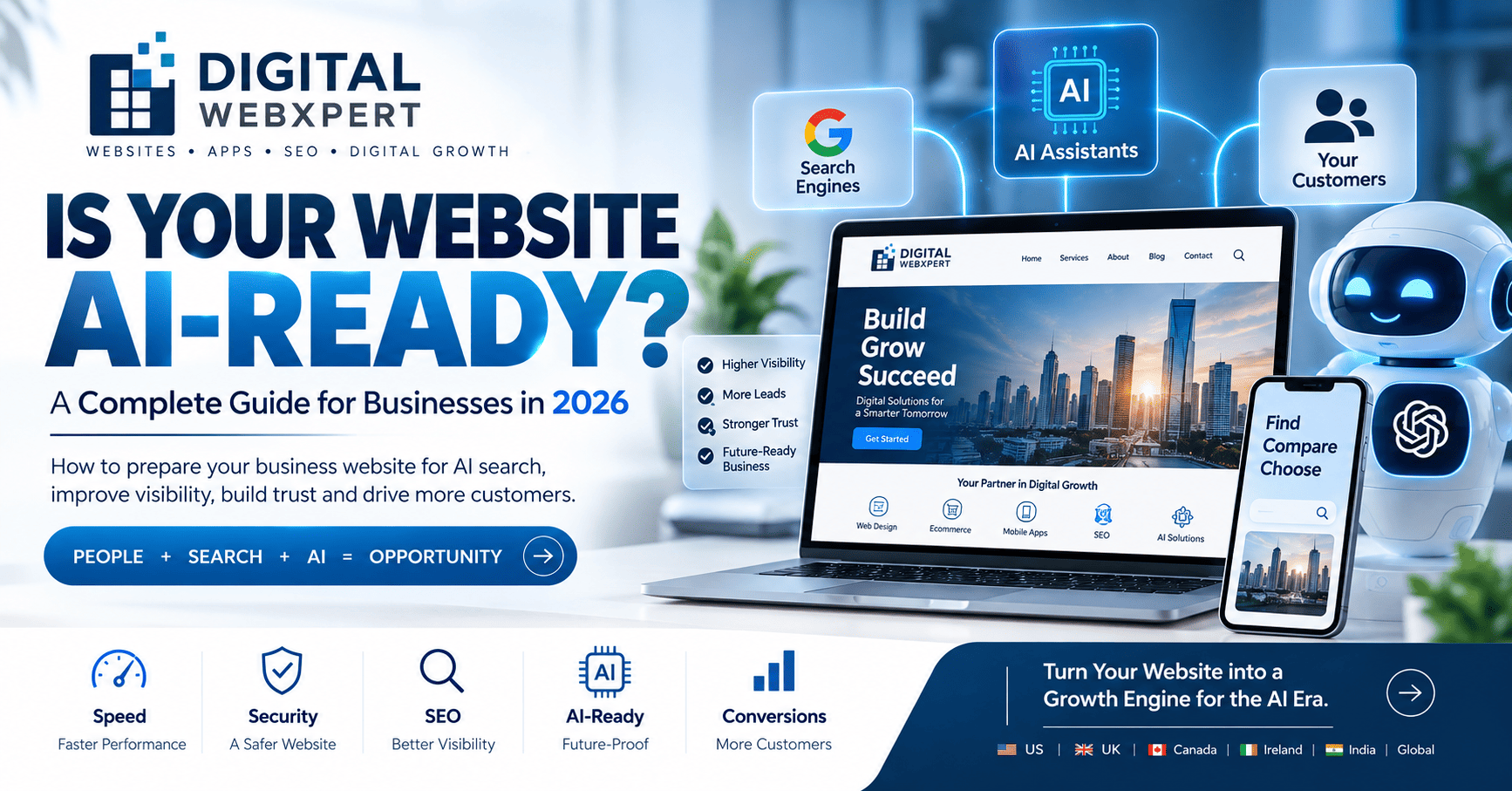
AI-Ready Website in 2026: How to Prepare Your Business for AI Search
Last Updated: September 16, 2026
Search is changing.
For years, businesses built websites primarily for two audiences: potential customers and traditional search engines. Companies invested in responsive web design, SEO, Google rankings, faster loading speeds and conversion-focused landing pages.
Those things are still essential.
But in 2026, there is another important layer to consider: AI-powered discovery.
Customers increasingly use AI-assisted search experiences to research products, compare services, understand complicated topics, find local businesses and make purchasing decisions.
Google itself now provides AI-powered experiences such as AI Overviews and AI Mode. Importantly, Google says that traditional SEO best practices remain relevant for these generative AI experiences. There is no separate magic optimization technique required simply because AI is involved.
At the same time, ecommerce is moving toward more structured interactions between businesses and AI-powered agents. Shopify, for example, now provides agentic-commerce infrastructure using the Universal Commerce Protocol, allowing compatible agents to discover products, work with carts and interact with checkout processes.
For businesses, this creates an important question:
Is your website ready to be understood not only by people and search engines, but also by increasingly sophisticated AI-powered discovery systems?
That is where the idea of an AI-ready website becomes important.
An AI-ready website is not simply a traditional website with a chatbot added to the bottom-right corner.
It is a website built around clarity, authority, technical accessibility, structured information, strong SEO foundations, fast performance, secure integrations and simple conversion paths.
In this guide, we will explain what an AI-ready website means in 2026, why businesses should care, what technologies matter, what does not matter, and how businesses can prepare their websites for the changing landscape of search and AI discovery.
What Is an AI-Ready Website?
An AI-ready website is a website structured so that people, search engines and relevant machine-driven systems can easily understand what the business does, who it serves, what products or services it offers, and how a visitor can take the next step.
A good AI-ready website should clearly communicate:
- Who the company is
- What services or products it provides
- Which locations it serves
- Who its ideal customers are
- How much products or services cost, where appropriate
- How the service works
- Why customers should trust the business
- Common customer questions
- Policies and important business information
- How visitors can enquire, book or purchase
This sounds simple, but many websites fail at it.
A website might look visually impressive while providing very little meaningful information.
For example, imagine a consultancy website whose homepage contains:
We transform possibilities into meaningful digital experiences.
That might sound polished, but it does not clearly explain what the company actually sells.
Compare it with:
We design and develop WordPress websites, Shopify stores and custom web applications for businesses in the UK, US, Canada and Ireland.
The second statement provides significantly more context.
Humans understand it immediately. Search engines can interpret it more easily, and machine-powered discovery systems have clearer information to work with.
That is one of the fundamental principles behind an AI-ready website:
Clarity beats vague marketing language.
Does AI SEO Replace Traditional SEO?
No.
One of the biggest misconceptions surrounding AI search is that traditional SEO has somehow become obsolete.
Google's official guidance in 2026 makes the opposite point: SEO fundamentals continue to matter because Google's generative AI search experiences are connected to its existing Search systems and index.
Google recommends many of the same fundamentals businesses should already be following:
- Allow appropriate crawling
- Make important content available as text
- Use internal links
- Create valuable and original content
- Provide a good page experience
- Ensure structured data matches visible content
- Keep business and merchant information accurate
Therefore, businesses should be cautious of anyone promising a completely separate secret formula for “AI SEO,” “GEO,” or “AEO.”
There are useful strategies for improving how clearly your website communicates information, but these should build upon strong SEO rather than replace it.
A sensible approach in 2026 is:
SEO + useful content + structured information + strong technical architecture + measurable AI visibility.
Why Your Business Needs an AI-Ready Website in 2026
Businesses do not need to rebuild their website every time a new technology appears.
However, the direction of online discovery makes several improvements increasingly valuable.
1. Customers Are Asking More Detailed Questions
Traditional searches were often short:
- Dentist Dublin
- Shopify developer London
- Mobile app developer Toronto
AI-assisted search encourages longer questions such as:
Which dental clinic in Dublin offers weekend appointments and accepts emergency patients?
Or:
Find a Shopify development company that can modernize an old store without rebuilding everything.
Websites containing clear, specific information have a better chance of being useful for these more detailed discovery journeys.
2. Search Is Becoming More Conversational
Users are increasingly comfortable asking complete questions instead of typing isolated keywords.
This means businesses should create content that answers genuine customer questions.
Instead of creating a page purely around:
website development company
a useful page might answer:
- How much does website development cost?
- Should I use WordPress, Shopify or custom development?
- How long does a business website take to develop?
- Can my existing website be redesigned without changing the domain?
- What should I prepare before contacting a web developer?
This produces content that is useful regardless of whether the visitor arrives through traditional Search, an AI-assisted search experience, social media or a referral.
3. Ecommerce Is Becoming More Machine-Readable
Shopify's current agentic-commerce developer infrastructure illustrates how ecommerce platforms are evolving.
Shopify's Universal Commerce Protocol tooling supports workflows around product discovery, carts, checkout and order state for compatible agents.
This does not mean every ecommerce transaction will suddenly be completed by an AI assistant.
It does mean that clean, structured product information is becoming even more valuable.
Merchants should pay close attention to:
- Accurate product names
- Descriptions
- Variants
- Availability
- Pricing
- Product images
- Shipping information
- Return policies
- Product identifiers
- Category structure
The ecommerce store of the future needs to function both as a visual storefront and as a structured commerce system.
AI-Ready Website vs Traditional Website
A traditional website and an AI-ready website may look similar to visitors.
The difference is often found underneath the design.
| Traditional Website | AI-Ready Website |
|---|---|
| Primarily designed for human visitors | Designed for people while also providing clear machine-readable structure |
| Basic SEO | Strong technical SEO and structured information |
| Generic service pages | Detailed, intent-focused service pages |
| Marketing-heavy language | Clear explanations of products and services |
| Limited structured data | Appropriate schema and structured data |
| Basic contact page | Clear enquiry, booking or purchasing pathways |
| Little attention to crawler controls | Deliberate crawling and indexing strategy |
| Scattered business information | Consistent organization and business details |
| No AI visibility measurement | Search and AI-discovery performance monitored |
| AI chatbot treated as the AI strategy | AI integrated only where it creates genuine business value |
The important point is that becoming AI-ready usually means improving the website fundamentals, not adding unnecessary technology.
12 Features Every AI-Ready Website Should Have
1. Clear Website Architecture
Your website structure should make sense.
A visitor should be able to move naturally from:
Home → Services → Specific Service → Case Study → Contact
An ecommerce journey might look like:
Home → Category → Product → Cart → Checkout
Search engines also use links to discover pages.
Avoid hiding valuable pages several levels deep without meaningful internal links.
2. Detailed Service and Product Pages
A common mistake is putting every service on one page.
If your business offers:
- Web design
- WordPress development
- Shopify development
- Mobile app development
- SEO
- AI integration
each important service deserves its own detailed page.
A strong service page should explain:
- What the service is
- Who it is for
- Business problems it solves
- Major features
- Your development process
- Expected timeline
- Related technologies
- Common questions
- Examples or case studies
- Next steps
This gives customers meaningful information while creating more context for search engines.
3. Helpful, Original Content
Mass-producing generic AI-written articles is not a sustainable SEO strategy.
Businesses should create content based on real expertise.
Examples include:
- Project lessons
- Implementation guides
- Original research
- Client questions
- Technical comparisons
- Industry-specific recommendations
- Case studies
- Troubleshooting guides
- Pricing explanations
- Process breakdowns
For DIGITAL WEBXPERT, a post such as:
How We Test a WordPress Website After a Major Update
has more original value than:
10 Benefits of Having a Website
Original experience is harder to commoditize.
4. Structured Data and Schema Markup
Structured data helps provide explicit information about page content.
Depending on the website, appropriate structured data may include:
- Organization
- LocalBusiness
- Product
- Article
- Breadcrumb
- SoftwareApplication
- Event
- JobPosting
- Video
However, an important point needs to be made:
There is no special “AI schema” required simply to appear in AI-powered Google Search experiences.
Schema should represent the information users can actually see on the page.
Do not add misleading structured data just because a plugin allows it.
5. Clear Business Entity Information
An AI-ready website should make it easy to determine who operates it.
Your business information should be consistent across your website.
Include information such as:
- Business name
- Logo
- About page
- Contact information
- Service area
- Social profiles
- Leadership or team information where appropriate
- Company history
- Genuine customer testimonials
- Policies
Local businesses should also maintain an accurate Google Business Profile.
Trust is not created by schema alone.
It comes from genuine business information supported by real evidence.
6. Fast Website Performance
Visitors do not care how technically sophisticated your website is if it feels slow.
Website performance remains fundamental.
Optimize:
- Images
- JavaScript
- CSS
- Fonts
- Caching
- Server response
- Database queries
- Plugins
- Third-party scripts
For WordPress websites, excessive plugins and poorly optimized page builders can create significant performance problems.
Shopify stores can become overloaded with:
- Tracking scripts
- Marketing apps
- Popups
- Review widgets
- Abandoned app code
Performance optimization should therefore be treated as an ongoing activity rather than something done once during development.
7. Mobile-First User Experience
Most businesses cannot treat mobile responsiveness as an optional feature.
Your AI-ready website should work smoothly across:
- Smartphones
- Tablets
- Laptops
- Desktops
Test:
- Navigation
- Forms
- Buttons
- Tables
- Images
- Videos
- Popups
- Checkout
- Account pages
- Booking flows
Responsive design should also consider accessibility and usability.
A page technically fitting on a mobile screen does not necessarily mean it provides a good mobile experience.
8. Search-Friendly Crawlability
A website cannot benefit from search visibility if important pages cannot be accessed appropriately.
Review:
robots.txtnoindexdirectives- Canonical tags
- XML sitemaps
- Authentication requirements
- CDN rules
- Firewall configuration
Be particularly cautious when changing CDN or bot-protection settings.
A security rule designed to block malicious automation can sometimes accidentally block legitimate crawlers.
Technical SEO and website security therefore need to work together.
9. AI Crawler Governance
AI readiness does not necessarily mean allowing every automated crawler unlimited access to everything.
Different automated systems may have different purposes.
Businesses should decide deliberately how they want content accessed.
Possible considerations include:
- Normal search indexing
- AI-powered search discovery
- AI agent access
- Training-related crawling
- Proprietary documents
- Member-only content
- Customer data
- Paid content
Crawler decisions should be made based on business goals, not fear or hype.
For many businesses, crawler governance should now be part of the website's wider SEO + security + AI readiness strategy.
10. Strong Internal Linking
Internal linking remains one of the simplest improvements many business websites neglect.
Imagine DIGITAL WEBXPERT publishes an article about:
AI-Ready Websites in 2026
That article could naturally link to relevant pages about:
- Website development
- SEO
- WordPress
- Shopify
- Mobile app development
- AI development
- Contact or request-a-quote
Those service pages should also link back to useful guides where appropriate.
This helps visitors explore the site while also helping search engines discover related content.
11. Clear Conversion Paths
Traffic alone does not pay the bills.
An AI-ready website should make the next step obvious.
Depending on the business, actions might include:
- Request a quote
- Schedule a consultation
- WhatsApp the business
- Make a booking
- Buy a product
- Start a trial
- Download a resource
- Request an audit
Avoid placing five competing CTAs in every section.
Identify the primary conversion action for each page.
For example:
Website Development Page
Primary CTA: Request a Website Consultation
SEO Article
Primary CTA: Get an SEO & AI Visibility Audit
Shopify Page
Primary CTA: Request a Shopify Store Review
The CTA should align with the visitor's intent.
12. Measurement and Analytics
One of the most important changes in modern SEO is the growing ability to measure visibility across AI-powered search experiences as well as traditional search.
Website owners should increasingly look beyond simple keyword ranking reports.
Measure:
- Organic impressions
- Organic clicks
- AI search visibility
- Landing pages
- Engagement
- Enquiries
- Bookings
- Ecommerce revenue
- Conversion rate
The most useful metric remains business impact.
Being mentioned or surfaced in an AI experience has limited value if it never contributes to:
- Qualified enquiries
- Purchases
- Subscriptions
- Meaningful brand discovery
How to Optimize an AI-Ready Website for Google Search
The good news is that businesses do not need to abandon their SEO strategy.
Strong fundamentals remain important.
Create Content Around Real Customer Intent
Do not build content exclusively around keyword volume.
Talk to customers.
Identify the actual questions they ask during sales conversations.
For a website-development company, questions may include:
- How much does a small business website cost?
- WordPress or custom development—which is better?
- Can WordPress handle ecommerce?
- Shopify or WooCommerce—which should I use?
- How long does website development take?
- Can you redesign my website without affecting SEO?
- Can my website integrate with my CRM?
- Can AI automate customer enquiries?
Each genuine question can become:
- A FAQ
- A service-page section
- A blog article
- A comparison guide
- A video
- A social post
Put Important Information in Text
Beautiful graphics are useful, but important business information should not exist only inside images.
For example, do not place your entire service list inside a banner graphic.
Write the services as actual page content.
The same applies to:
- Pricing
- Features
- Locations
- FAQs
- Product specifications
- Policies
Strengthen Topical Authority
Instead of publishing random articles, build useful topic clusters.
Core Topic: WordPress Development
Supporting content:
- WordPress maintenance guide
- WordPress security checklist
- WordPress vs custom development
- WordPress speed optimization
- WordPress SEO checklist
- WooCommerce optimization
- WordPress update testing
Core Topic: Shopify Development
Supporting content:
- Shopify SEO
- Shopify speed optimization
- Shopify product data
- Shopify conversion optimization
- Shopify AI commerce
- Shopify integrations
Topic clusters help create a more coherent information architecture than disconnected articles written solely because a keyword tool showed search volume.
How to Make a WordPress Website AI-Ready
WordPress remains an excellent option for many business websites because of its flexibility.
However, an old WordPress installation filled with unnecessary plugins is not automatically AI-ready.
Start by auditing the foundation.
WordPress AI-Ready Checklist
- WordPress core version
- PHP version
- Theme quality
- Plugin quality
- Security
- Backups
- Caching
- Database performance
- XML sitemap
- Indexing
- Schema
- Service pages
- Internal linking
- Forms
- Conversion tracking
- Mobile performance
Remove plugins that provide no meaningful value.
Keep the platform updated.
Use a staging environment for significant changes.
Test important functionality after updates.
And most importantly, do not install an AI chatbot merely to claim your website uses AI.
Use AI only when it solves a real problem.
Useful examples might include:
- Intelligent enquiry qualification
- Internal knowledge search
- Customer-support assistance
- Quotation assistance
- Content-editor support
- Workflow automation
How to Make a Shopify Store AI-Ready
Ecommerce deserves special attention because product data is highly structured.
Shopify's agentic-commerce infrastructure demonstrates how AI-powered systems can work with product catalogues, carts and checkout processes through structured capabilities.
For Shopify merchants, an AI-ready store should therefore prioritize catalogue quality.
Product Title
Does the title accurately identify what the product is?
Product Description
Does it explain:
- Features
- Benefits
- Materials
- Dimensions
- Compatibility
- Use cases
Variants
Are sizes, colours and other options structured correctly?
Images
Are product images clear, useful and properly optimized?
Availability
Does inventory information remain accurate?
Policies
Are shipping and return policies easy to find?
Product Schema
Does structured data accurately represent the visible product information?
Merchant Information
Are your brand details and customer-support information consistent?
A beautifully designed store cannot compensate indefinitely for disorganized product data.
Does Your Website Need an AI Chatbot?
Not necessarily.
This is another major misconception.
An AI chatbot does not automatically make a website AI-ready.
Some businesses genuinely benefit from conversational tools.
Examples include businesses handling large volumes of repetitive questions, complex product catalogues or extensive knowledge bases.
But for other businesses, a well-designed:
- Contact form
- Booking flow
- WhatsApp button
- FAQ
- Live chat
may provide a better customer experience.
Before implementing AI, ask:
What problem are we solving?
Then ask:
Can we measure whether the AI feature improves the result?
If the answer to both questions is unclear, the business probably does not need the feature yet.
AI-Ready Website Security
The more integrations a website has, the more carefully security must be considered.
AI-enabled website features may connect with:
- Customer databases
- CRMs
- Payment systems
- Calendars
- Internal documents
- APIs
- Third-party platforms
Therefore, AI functionality should include sensible controls such as:
- Authentication
- Authorization
- Rate limiting
- Input validation
- Logging
- Secure API keys
- Usage limits
- Monitoring
Never expose private API credentials inside frontend JavaScript.
Do not give an AI-powered feature unrestricted access to sensitive customer information simply because integration is technically possible.
An AI-ready website must also be a secure website.
How Much Does an AI-Ready Website Cost?
There is no universal price because the work required depends on the current condition of the website and the business requirements.
A small local business website may simply need:
- Better content
- Technical SEO
- Structured data
- Improved performance
- Clearer service pages
- Better conversion paths
An ecommerce business may require:
- Product-data cleanup
- Feed optimization
- Shopify development
- Schema improvements
- Merchant Center work
- Custom integrations
A software company may require:
- A custom web application
- Authenticated accounts
- AI integrations
- APIs
- Payment systems
- Dashboards
Therefore, businesses should usually start with an AI-ready website audit rather than purchasing technology they may not need.
A good audit should identify:
- Current SEO issues
- Crawlability problems
- Website performance
- Content gaps
- Structured-data opportunities
- AI visibility
- Conversion problems
- Security considerations
- Recommended priorities
AI-Ready Website Checklist for 2026
Technical Foundation
- ☐ HTTPS enabled
- ☐ Website mobile-friendly
- ☐ Pages load quickly
- ☐ XML sitemap available
- ☐ Important pages crawlable
- ☐ Correct canonical tags
- ☐ No accidental noindex directives
- ☐ Broken links fixed
Content
- ☐ Business clearly explained
- ☐ Individual service pages
- ☐ Product and service benefits explained
- ☐ Customer questions answered
- ☐ Original expert content
- ☐ Case studies or evidence
- ☐ About and company information
SEO
- ☐ Unique page titles
- ☐ Useful meta descriptions
- ☐ Logical heading structure
- ☐ Internal links
- ☐ Descriptive image ALT text
- ☐ Structured data where appropriate
- ☐ Search Console configured
Local Business
- ☐ Accurate business name
- ☐ Consistent contact details
- ☐ Google Business Profile
- ☐ Service area or location information
- ☐ Customer reviews
AI Readiness
- ☐ Important information available as text
- ☐ Clear product and service structure
- ☐ AI crawler strategy reviewed
- ☐ Search crawler accessibility reviewed
- ☐ No unnecessary AI-specific files added based purely on hype
- ☐ AI visibility monitored where available
Conversion
- ☐ Clear primary CTA
- ☐ Contact forms tested
- ☐ Phone and WhatsApp easy to access
- ☐ Booking flow works
- ☐ Ecommerce checkout tested
- ☐ Conversion tracking enabled
Security
- ☐ Software updated
- ☐ Backups configured
- ☐ Admin access protected
- ☐ APIs secured
- ☐ AI integrations monitored
- ☐ Sensitive information protected
If a large number of these items are missing, your website may be ready for a modernization project.
Common AI Website Optimization Mistakes
Mistake 1: Creating Hundreds of Generic AI Articles
More pages do not automatically mean more visibility.
Focus on quality, originality and usefulness.
Mistake 2: Keyword Stuffing
Repeating AI-ready website unnaturally throughout every paragraph will not improve the reader's experience.
Use your target keywords naturally.
Mistake 3: Installing Every AI Plugin Available
Each unnecessary plugin can increase:
- Maintenance
- Security risk
- Performance overhead
- Complexity
Use technology because it solves a problem.
Mistake 4: Ignoring Traditional SEO
AI search has not eliminated technical SEO.
Crawlability, internal linking, indexability, useful content and good user experience remain important.
Mistake 5: Assuming Schema Guarantees AI Citations
Structured data helps communicate meaning, but it does not guarantee rankings, rich results or AI mentions.
Mistake 6: Optimizing for Robots Instead of Customers
The purpose of the website is still to help people.
If an optimization makes your website worse for humans simply because somebody claims an AI crawler prefers it, reconsider it.
Measuring Whether Your AI-Ready Website Is Working
Do not measure success based on a single keyword.
Track business outcomes.
Useful metrics include:
- Organic traffic
- Search impressions
- AI search visibility
- Qualified enquiries
- Phone calls
- WhatsApp conversations
- Appointment bookings
- Sales
- Revenue
- Lead quality
- Conversion rate
Combine this information with analytics and CRM data.
For example:
AI/Search Visibility → Website Visit → Service Page → Enquiry → Qualified Lead → Sale
That is much more valuable than celebrating an impression count without knowing whether it creates business.
Frequently Asked Questions About AI-Ready Websites
What is an AI-ready website?
An AI-ready website is designed so that customers, search engines and relevant AI-powered systems can understand its content clearly. It combines strong SEO, useful content, structured information, performance, security and clear conversion pathways.
Do I need a special AI SEO plugin?
Usually, no.
There is no single plugin that automatically makes a website AI-ready. Start with strong technical SEO, useful content, structured data, crawlability and clear site architecture.
Does Google require special AI schema?
No.
Google does not require a special AI-specific schema simply for participating in its AI-powered search experiences. Existing structured-data and SEO best practices remain relevant.
Do I need an llms.txt file to appear in Google AI results?
Businesses should not treat any single AI-related file as a shortcut to visibility.
The stronger approach is to maintain a technically accessible, useful, authoritative and well-structured website.
Can ChatGPT and AI assistants find my website?
AI systems differ in how they access, retrieve and use web information.
The practical strategy is to maintain a technically accessible, authoritative website with clear information and strong search visibility rather than optimizing around assumptions about one particular assistant.
Is WordPress suitable for an AI-ready website?
Yes.
A well-built WordPress website can have excellent SEO, structured data, fast performance and AI-powered integrations.
The quality of implementation matters more than the CMS name.
Can Shopify be optimized for AI shopping?
Yes.
For ecommerce businesses, high-quality product information is increasingly important.
Merchants should focus on clean product data, accurate variants, pricing, availability and clear policies.
Should I block AI crawlers?
There is no universal answer.
Your decision should depend on:
- Business goals
- Intellectual-property strategy
- Search objectives
- Content type
- Desired AI visibility
- The specific crawler
Do not block entire classes of crawlers without understanding the consequences.
How do I know whether my website is AI-ready?
Start with a technical and content audit covering:
- SEO
- Crawlability
- Structured data
- Content quality
- Business information
- Performance
- Conversion
- Analytics
- Security
- Crawler governance
Then prioritize the changes most likely to affect customers and business results.
The Future of Websites Is Not “AI Everywhere”
The future is not about inserting artificial intelligence into every page.
Businesses do not need animated AI characters, ten chatbots and dozens of automated features.
The better approach is simpler:
- Build websites that communicate clearly.
- Publish information customers genuinely need.
- Structure products and services properly.
- Make websites fast and accessible.
- Keep search engines able to find important content.
- Use structured data accurately.
- Measure search and AI visibility.
- Use AI where it removes friction or improves the customer experience.
That is what an AI-ready website should mean.
Technology will continue changing.
AI platforms will change.
Search interfaces will change.
Browsers will change.
But businesses that maintain clear information, useful content, strong technical foundations and excellent customer experiences will be better positioned to adapt.
Make Your Business Website AI-Ready
Your website should no longer function as a static online brochure.
It should be an active part of your business growth system.
A modern business website should help customers:
- Discover your company
- Understand your services
- Trust your expertise
- Compare solutions
- Ask questions
- Contact you
- Book
- Purchase
At the same time, it should provide clear and structured information that search engines and emerging AI-powered discovery systems can understand.
At DIGITAL WEBXPERT, we help businesses build and modernize websites for today's search environment and tomorrow's AI-powered digital landscape.
Our services include:
- Professional website design
- WordPress development
- Shopify development
- Custom web applications
- Mobile app development
- SEO
- Website performance optimization
- Business automation
- AI integration
- AI-ready website development
Whether your business operates in the United States, United Kingdom, Canada, Ireland or India, we can review your existing digital presence and identify practical opportunities to improve visibility, performance and conversions.
Is Your Website AI-Ready?
Request a FREE AI-Ready Website Check.
We can identify three practical improvements that could make your website easier for customers, search engines and emerging AI discovery systems to understand.
DIGITAL WEBXPERT
Web Design • WordPress • Shopify • Mobile Apps • SEO • AI-Ready Websites
