
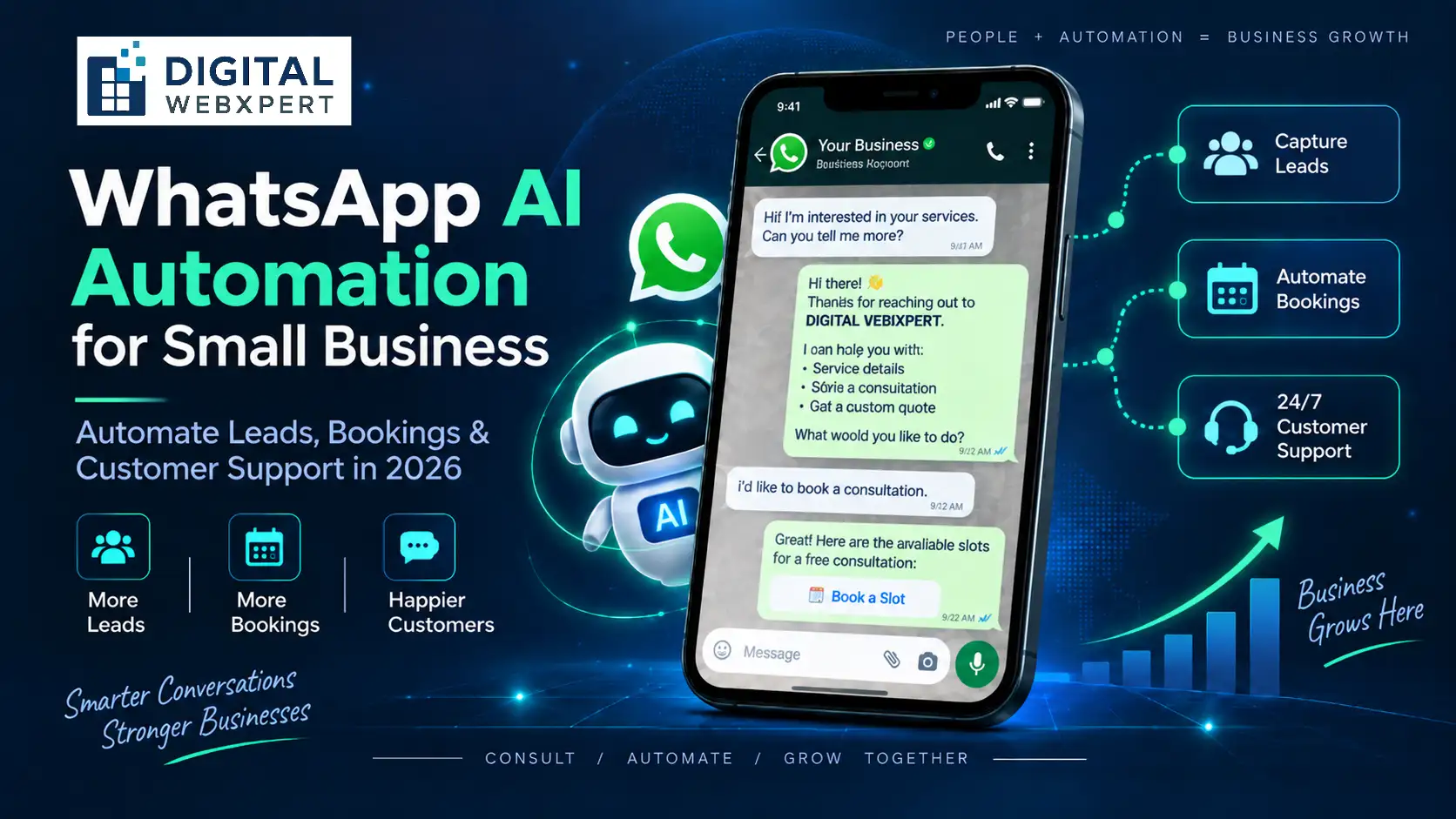
A potential customer discovers your business at 11:30 PM.
They have a simple question:
“How much does your service cost?”
They send you a WhatsApp message.
Nobody replies because your team has finished work for the day.
The customer waits for a few minutes, searches again and messages another business. That competitor responds immediately.
By the time you check WhatsApp the next morning, the opportunity may already be gone.
This is one of the reasons WhatsApp AI automation is becoming increasingly important for small businesses in 2026.
WhatsApp is no longer simply a place where businesses manually answer messages. With artificial intelligence, automation, APIs and business systems working together, WhatsApp can become part of a complete customer acquisition and support workflow.
An AI-powered WhatsApp system can potentially understand an enquiry, answer common questions, collect customer information, recommend services, qualify a lead, arrange an appointment and transfer the conversation to a human when required.
Meta introduced Business AI capabilities for eligible businesses on WhatsApp, including answering customer questions, helping capture leads, recommending products and supporting appointment-related workflows.
For businesses, the important question is therefore changing from:
“Should we use WhatsApp?”
to:
“How much of our customer journey can we intelligently automate through WhatsApp?”
What Is WhatsApp AI Automation?
WhatsApp AI automation combines WhatsApp messaging with artificial intelligence, predefined business rules and integrations with other business systems.
A traditional WhatsApp automation might work like this:
Customer: I need AC repair.
System:
Press 1 for installation.
Press 2 for repair.
Press 3 for servicing.
This approach can be useful, but it forces the customer into a fixed menu.
An AI-powered system can provide a more natural interaction.
Customer: My AC is running but it isn't cooling properly. Can someone visit tomorrow afternoon?
An AI agent could potentially understand that the customer needs an AC repair or inspection, ask for the location, collect contact details, determine a preferred time and create a structured service request.
The important difference is understanding customer intent rather than simply matching menu options.
Why WhatsApp AI Matters for Small Businesses in 2026
Small businesses often face a difficult problem.
Customers expect fast responses, but smaller companies cannot always employ customer-support teams around the clock.
The business owner may be managing operations, customers, sales, suppliers and employees at the same time.
WhatsApp messages accumulate.
Some enquiries are answered late. Some are accidentally forgotten. Others repeatedly ask exactly the same questions:
- What is the price?
- Where are you located?
- Do you provide this service in my area?
- Can I book for tomorrow?
- Do you have this product?
- What time do you open?
- Can someone call me?
AI can handle a significant portion of these repetitive conversations while allowing employees to concentrate on situations that genuinely require human attention.
WhatsApp Can Become More Than a Chat Inbox
Many companies still treat WhatsApp as a digital telephone.
Someone sends a message and somebody manually replies.
That works while enquiry volume remains low.
But as a company grows, WhatsApp can become increasingly difficult to manage.
A connected customer journey could instead look like:
Google Search → Website → WhatsApp → AI Agent → Lead Qualification → Booking → CRM → Human Follow-Up
Or:
Instagram Ad → WhatsApp → AI Conversation → Service Recommendation → Customer Details → Sales Team
Or even:
Existing Customer → WhatsApp → Support Request → AI Assistance → Ticket Creation → Human Escalation
WhatsApp then becomes part of your business infrastructure rather than simply another communication app.
1. Respond to Customer Enquiries 24/7
One of the biggest advantages of WhatsApp AI automation is availability.
Customers do not always contact businesses during office hours.
Someone might research your services after dinner. Another potential customer may see your Instagram advertisement on Sunday. Someone else may want a quotation early in the morning.
Without automation, those customers could wait hours before receiving a response.
An AI agent can provide an immediate first response and help keep the prospect engaged.
For example, a website development company could answer common questions about:
- Website development
- eCommerce development
- Mobile applications
- SEO services
- AI automation
- Portfolio information
- Project requirements
- Consultation availability
The goal is not necessarily to replace the salesperson.
The goal is to make sure the conversation starts immediately.
2. Automatically Capture and Qualify Leads
Receiving more enquiries is useful.
Receiving better structured enquiries is even more valuable.
Suppose someone sends:
“I need an app.”
A salesperson normally needs to ask several follow-up questions before understanding the project.
An intelligent WhatsApp workflow could ask:
- What type of app are you planning?
- Will customers need accounts?
- Do you need Android, iOS or both?
- Will the app accept online payments?
- Do you need an admin panel?
- When would you like to launch?
Once these questions are answered, your sales team receives a much more useful lead.
Instead of:
Name: Rahul
Message: Need app
Your team could receive:
Project: Home service booking app
Platforms: Android + iOS
Customer Login: Required
Payment Gateway: Required
Admin Panel: Required
Target Launch: 3 months
Contact Preference: Phone call
Your salesperson can start with context instead of spending the beginning of the conversation collecting basic information.
3. Automate Appointment and Booking Requests
Clinics, salons, consultants, service companies, coaches and repair businesses frequently receive appointment enquiries through WhatsApp.
A customer might write:
“Can I book an appointment tomorrow after 4 PM?”
A connected AI workflow could identify the requested date and time, check available slots through an integrated booking system and present suitable options.
After confirmation, the system could create the booking and send the appropriate information to the customer.
Even when direct booking integration is not required, AI can collect the appointment request and pass it to staff in a structured format.
4. Answer Frequently Asked Questions Instantly
Every business has questions customers ask repeatedly.
For a restaurant:
- Are you open today?
- Do you offer home delivery?
For a clinic:
- What is the consultation fee?
- Where is the clinic located?
For an eCommerce business:
- When will my order arrive?
- Do you accept Cash on Delivery?
For a digital agency:
- How much does a website cost?
- Do you develop Android and iOS apps?
Traditional FAQ pages can answer many of these questions, but customers do not always want to browse through multiple pages.
They increasingly expect to ask the question directly.
An AI assistant can provide conversational answers using approved business information.
Accuracy, however, is critical.
The AI should not invent pricing, policies, availability or guarantees. A properly designed implementation needs trusted information sources, clear instructions and escalation rules.
5. Recommend the Right Product or Service
AI becomes particularly valuable when customers do not know exactly what they need.
Consider someone messaging a digital agency:
“I run a small coaching centre and want students to register online. What should I build?”
A basic chatbot might simply display a list of services.
An AI agent could instead ask questions about registrations, payments, student accounts, online courses and administration before suggesting an appropriate solution.
The same approach can work for eCommerce.
“I need a birthday gift for my wife under ₹3,000.”
A connected AI assistant could potentially identify appropriate products from the business catalogue and guide the customer toward a purchase.
This moves messaging beyond customer support and into guided product discovery and conversational sales.
6. Follow Up With Leads More Efficiently
Many sales opportunities are lost not because customers rejected an offer, but because nobody followed up at the right time.
A prospect requests information.
The business responds.
The customer becomes busy.
Several days pass and the conversation disappears beneath newer messages.
Automation can help create structured follow-up processes.
For example:
- Day 0: Customer requests information.
- Day 1: Salesperson provides the quotation.
- Day 3: Appropriate follow-up is triggered.
- Day 7: Lead is assigned for manual review.
Businesses should always respect customer consent, WhatsApp messaging policies and applicable communication regulations.
The goal is useful follow-up — not spam.
7. Transfer Important Conversations to Humans
One of the biggest misconceptions about AI customer service is that every conversation should remain automated.
It should not.
Some situations clearly need a human:
- A customer is unhappy.
- A quotation requires negotiation.
- A technical issue is unusual.
- A high-value prospect requests a consultation.
- The customer explicitly asks to speak with someone.
A strong AI workflow should recognize these situations and escalate them.
AI for speed. Humans for judgement.
AI Agent vs Traditional WhatsApp Chatbot
The terms “chatbot” and “AI agent” are often used interchangeably, but they can represent very different systems.
A traditional chatbot usually follows predefined rules.
If the customer chooses option A, show response B.
An AI agent can understand more natural customer language and potentially determine which approved action or workflow should happen next.
A traditional chatbot might say:
Choose your requirement:
1. Website
2. Mobile App
3. SEO
An AI-powered assistant could receive:
“We already have a WordPress site but it is slow, doesn't rank well and looks bad on mobile. Can you help?”
The AI can identify several relevant requirements from the same message: redesign, performance improvement, mobile responsiveness and SEO.
This creates a more natural customer experience.
Which Businesses Can Benefit From WhatsApp AI Automation?
WhatsApp automation is not limited to online stores.
It can be useful wherever businesses receive repeated customer enquiries before delivering a product or service.
- Home service providers
- Clinics and dental practices
- Real estate businesses
- Restaurants
- Hotels
- Travel businesses
- Coaching institutes
- Schools and training organisations
- Salons and beauty businesses
- Gyms and fitness centres
- Automobile businesses
- Professional consultants
- Local retailers
- eCommerce stores
- Software companies
Consider a home-service company.
“Need plumber urgently near City Centre.”
The system could collect:
Service Required → Location → Problem Description → Preferred Visit Time → Customer Details
The admin team then receives an actionable service request.
For a clinic, the same concept could collect appointment details. For an agency, it could collect project requirements. For an online store, it could help customers discover products.
The technology may be similar, but the workflow should be designed specifically for each business.
What Does a Complete WhatsApp AI System Look Like?
For many businesses, WhatsApp itself is only the customer-facing layer.
A complete workflow might look like this:
Customer
↓
WhatsApp
↓
AI Agent
↓
Business Knowledge Base
↓
Lead / CRM System
↓
Booking or Order System
↓
Notifications
↓
Human Team
The AI should only have access to the information and actions required for its specific role.
For example, a sales assistant may need service information and lead-creation capabilities, but it should not automatically receive access to sensitive administrative information.
This is why custom implementation can become important for businesses with more advanced workflows.
Can WhatsApp AI Replace Customer Service Employees?
For most businesses, replacing employees should not be the primary objective.
AI works particularly well with repetitive tasks.
Humans remain much better suited to situations involving judgement, negotiation, relationships, unusual requirements and sensitive customer issues.
Think of AI as the first layer of response.
It can collect information, solve straightforward questions and route conversations.
Your team can then spend more time on conversations where human involvement creates the most value.
What Should Your Business Automate First?
Trying to automate everything on day one is usually unnecessary.
Start with the conversations that already happen repeatedly.
Review recent WhatsApp enquiries and identify patterns.
You may discover that most questions relate to:
- Pricing
- Availability
- Location
- Service area
- Appointment times
- Product availability
- Order updates
- Quotation requests
Build automation around real customer behaviour rather than imaginary scenarios.
Additional workflows can then be introduced gradually.
Don't Automate a Broken Business Process
AI cannot fix a process that nobody understands.
Before introducing automation, define what should happen when a customer contacts you.
Ask questions such as:
- Where should new leads go?
- Who receives urgent enquiries?
- What information is needed before preparing a quotation?
- Which questions can AI answer?
- Which questions require human intervention?
- What happens when the AI cannot confidently answer?
- Who is responsible for updating business information?
These decisions matter more than simply adding a chatbot button.
The best AI automation starts with a clear business workflow.
Website + WhatsApp + AI: A Powerful Combination
Some businesses assume WhatsApp can replace their website.
In most cases, they work better together.
Your website provides discoverable and structured information about your company, services, products, expertise, portfolio and reputation.
WhatsApp reduces friction when the visitor is ready to ask a question.
Imagine somebody reading your mobile app development page.
Instead of completing a long contact form, they click:
Discuss Your App Idea on WhatsApp
The conversation opens with context already attached.
“Hi, I'm interested in developing a mobile application.”
An AI assistant could immediately continue the conversation and start collecting project requirements.
This creates a shorter path from:
Website Visitor → Conversation → Qualified Lead
For businesses investing in SEO, paid advertising and social media, this connection can be especially valuable.
WhatsApp AI and the Future of Conversational Commerce
Messaging platforms are evolving from communication channels into places where discovery, customer service and commercial interactions can happen.
Customers increasingly expect to ask natural questions such as:
- Is this available?
- Which package is right for me?
- Can you book me for Friday?
- Can someone call me?
- Which service would you recommend?
Instead of navigating several pages and waiting for an employee, customers may increasingly complete much of their initial journey inside a conversation.
For small businesses, that creates an opportunity to make customer journeys faster and easier without necessarily increasing support staff.
How to Prepare Your Business for WhatsApp AI Automation
You do not need to automate your entire company immediately.
Start by understanding your existing customer conversations.
A practical implementation can be divided into phases.
Phase 1: FAQ and Lead Capture
Answer frequently asked questions and collect basic customer information.
Phase 2: Lead Qualification
Ask relevant questions and categorize leads based on the customer's requirements.
Phase 3: Appointment or Service Request Integration
Allow customers to request appointments, consultations or service visits.
Phase 4: CRM and Follow-Up Automation
Connect qualified enquiries with your CRM, sales pipeline or internal system.
Phase 5: Advanced AI Agent Workflows
Add more advanced actions, integrations and personalized customer journeys once the core workflow is performing reliably.
This phased approach reduces complexity while allowing automation to evolve based on actual customer behaviour.
The Real Opportunity Is Not AI — It Is Faster Customer Journeys
Businesses should not implement AI simply because everyone is talking about AI.
The better question is:
Where are our customers waiting unnecessarily?
If customers wait six hours for a basic answer, there is an automation opportunity.
If employees repeatedly copy and paste the same response, there is an opportunity.
If salespeople spend significant time collecting basic information from every lead, there is an opportunity.
If enquiries disappear because nobody follows up, there is an opportunity.
AI automation becomes useful when it removes friction from those moments.
Technology should serve the customer journey — not the other way around.
Final Thoughts
WhatsApp is already one of the most important communication channels between businesses and customers, especially in markets such as India.
Artificial intelligence is now adding another layer.
Instead of simply receiving messages, businesses can build intelligent workflows that answer questions, collect leads, understand requirements, recommend services, arrange appointments and involve employees when human attention is required.
That does not mean every conversation should be automated.
The strongest customer experience will often come from finding the right balance.
Automate repetitive work.
Keep humans involved where judgement matters.
Make it easier for customers to get answers.
Connect conversations to real business processes.
And most importantly:
Don't make customers wait unnecessarily when technology can help you respond immediately.
Want to Know What Your Business Can Automate on WhatsApp?
Your business may already be receiving customer conversations that could be handled more efficiently.
DIGITAL WEBXPERT can help you plan and build a WhatsApp AI automation workflow tailored to your business.
We can help with:
- WhatsApp AI agents and chat automation
- Customer enquiry automation
- Lead capture and qualification
- Appointment and service-request workflows
- Website-to-WhatsApp integration
- CRM and API integrations
- Custom admin panels
- AI-powered customer support
- Custom business software
- Mobile application development
You don't need to know which AI platform or technology to use.
Tell us how customers currently contact your business and what happens after they send a message.
We can help identify where automation could save time, improve response speed and create a better customer experience.
Get Your Free WhatsApp Automation Consultation
Website: https://www.digitalwebxpert.com/
Email: info@digitalwebxpert.com
Frequently Asked Questions About WhatsApp AI Automation
What is WhatsApp AI automation?
WhatsApp AI automation uses artificial intelligence and automated workflows to understand customer messages, answer common questions, collect information and connect conversations with systems such as CRM software, booking platforms or internal business applications.
Can AI automatically answer WhatsApp customers?
Yes. Depending on the solution and available WhatsApp capabilities, AI can answer approved customer questions using business information and predefined rules. Human escalation should remain available for complex or sensitive enquiries.
Can WhatsApp AI generate leads?
Yes. An AI workflow can collect customer names, requirements, locations, budgets, preferred times and other qualifying information before passing the lead to a salesperson or CRM.
Can WhatsApp AI book appointments?
Yes. With the appropriate integration, an AI assistant can collect appointment requests and potentially connect with calendars or booking systems to manage availability.
Is WhatsApp AI suitable for small businesses?
It can be especially useful for small businesses receiving repetitive enquiries but without staff available to respond continuously.
Is WhatsApp AI the same as a chatbot?
Not necessarily. Traditional chatbots normally depend heavily on predefined menus and rules. AI agents can understand more natural customer messages and potentially determine which approved workflow should happen next.
Will WhatsApp AI replace employees?
That should not normally be the goal. A better approach is to automate repetitive questions and administrative tasks while employees handle complex situations, negotiation and relationship-based conversations.
How much does WhatsApp AI automation cost?
Cost depends on message volume, the WhatsApp solution being used, AI provider, integrations, CRM requirements and the level of custom development required.
A basic FAQ and lead-capture workflow is usually simpler than a system connected with booking, payment, CRM and internal business software.
Can my existing website be connected to WhatsApp AI?
Yes. Website buttons, landing pages, advertisements and contact flows can direct customers into WhatsApp conversations. The automation can then continue the lead journey based on the customer's requirement.
How do I start WhatsApp AI automation for my business?
Start by identifying your most common customer questions and mapping what your team currently does after receiving each type of enquiry. Then decide which steps can safely be automated and which should continue to involve a human.
